
New energy vehicle projects are moving fast, but the drive motor choice is moving even faster. In many platforms, the discussion has shifted from “Does this EV concept work?” to “Which motor tech fits the real duty cycle?” That is why PMSM technology for new energy vehicles keeps showing up in design reviews, especially when you compare induction motors in electric vehicles against modern permanent magnet solutions. The change is not about hype. It is about efficiency where you actually drive, torque where you actually start, and heat where you least want it.
How Induction Motors Work in Traditional EV Platforms
Before the comparison gets heated, it helps to frame what induction motors do well and why they were used in EV platforms in the first place. Induction machines are proven, widely supported, and can be cost-effective in certain designs.
Basic Operating Principle of Induction Motors
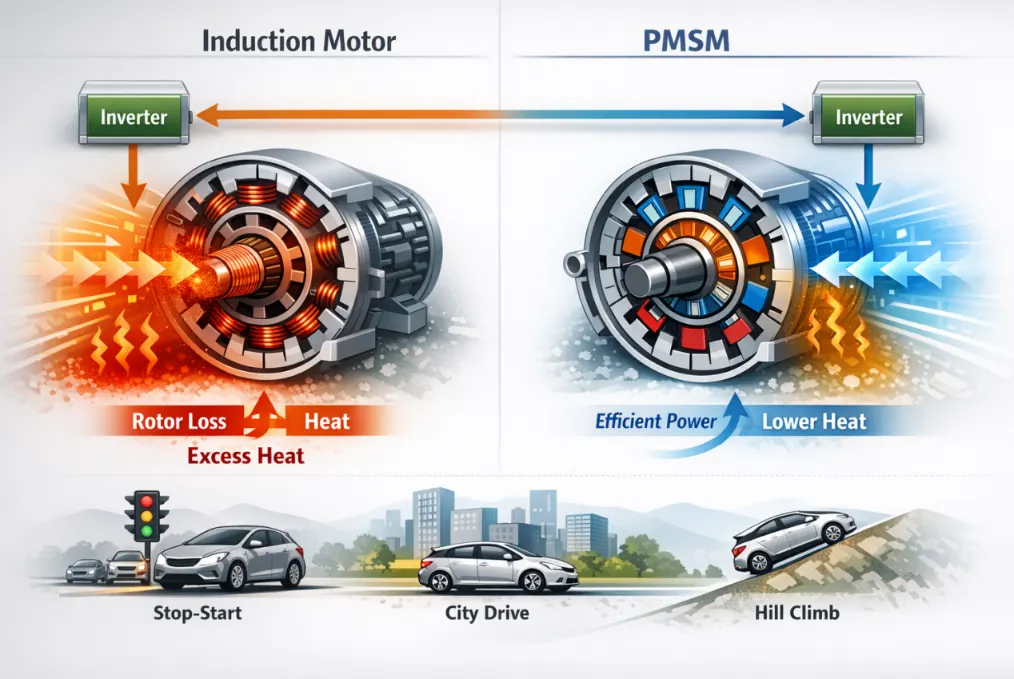
Induction motors in electric vehicles rely on rotor current to create the rotor magnetic field. The stator produces a rotating field, and the rotor “chases” it with a small speed difference (slip). That slip is not just a theory detail. It is tied to rotor copper loss and heat, especially when the load changes often.
In practical EV duty, that means the rotor is spending energy to create its field while also trying to deliver torque. Over long operation, losses add up, and electric vehicle motor efficiency can drop in the parts of the cycle where the vehicle spends most of its time.
Where Induction Motors Still Perform Well
Induction motors still make sense in some cases. If your platform is cost-driven, your operating range is relatively narrow, or your system constraints are built around existing induction solutions, an induction motor can be a reasonable pick.
They are also familiar to many teams, and supply chains are mature. That matters when you are trying to ship vehicles, not just build a prototype that looks good in a lab.
How PMSM Technology Changes the Drive Motor Equation
The argument for PMSM starts with structure, then quickly moves into system behavior. Once you see how PMSM produces torque and where its losses go, the replacement trend becomes easier to explain.
Rotor Magnetic Field Without Excitation Loss
A permanent magnet synchronous motor used in electric vehicle platforms generates its rotor field using permanent magnets rather than induced rotor current. That removes excitation loss in the rotor. In plain terms, less energy is wasted making the motor “ready to work.”
So when you compare PMSM vs induction motor in electric vehicles, the efficiency gap shows up most clearly in variable load operation. A PMSM motor used in electric vehicle duty can maintain strong efficiency without asking the battery and inverter to push extra current just to build rotor field.
Torque Density and Compact Motor Design
PMSM often delivers more torque for the same frame size. That higher power density electric motor performance can help you keep packaging tight, reduce drivetrain bulk, or leave more room for cooling and wiring. If you have ever tried to fit components into a small utility EV chassis, you already know how valuable a few centimeters can be.
A more compact traction unit can also reduce mechanical compromises. Less “forced fit” usually means fewer headaches later.
Why New Energy Vehicle Duty Cycles Favor PMSM
The motor decision is rarely about peak power. It is about what the vehicle does all day. City routes, short hops, ramps, payload changes, and start-stop behavior shape the real energy bill.
Stop-Go Urban Driving and Low-Speed Operation
In typical city duty, torque in electric vehicles matters at low speed far more than peak power at high speed. Starting from a stop, climbing a ramp, pulling away with a load, those moments are small, but frequent. That is where drivers feel the difference, and where your system sees repeated current spikes.
A traction motor in EV setups with PMSM control can deliver stable torque from very low speed, which helps drivability and reduces the “hesitation” that can show up with weaker low-speed torque. This is one reason PMSM in electric vehicles keeps expanding from passenger EVs into utility and work platforms.
Partial Load Efficiency Over Full Load Efficiency
Most electric vehicles run at partial load for a large share of the day. They cruise, slow down, creep, accelerate gently, then repeat. That is why EV motor efficiency under partial load matters so much.
This is also where “why PMSM replaces induction motor” becomes a practical question, not a marketing line. In many real cycles, PMSM in electric vehicles tends to hold higher efficiency between roughly 20% and 70% load than induction designs. Over time, that translates into range stability, less battery stress, and less heat dumped into the motor bay.
Thermal Behavior and Long-Term Reliability in NEVs
Heat is the quiet killer in EV drivetrains. It does not usually fail dramatically on day one. It shortens insulation life, dries grease, stresses bearings, and makes controllers work harder. If a vehicle runs long hours, you feel that cost.
Lower Rotor Heat Generation
Rotor heating is a key difference between motor types. Because induction motors in electric vehicles create rotor current as part of normal operation, rotor losses and internal heating are hard to avoid. Under long or variable duty, that heat can rise fast.
Permanent magnet synchronous motor used in electric vehicle applications typically reduces that rotor loss. Better thermal performance of EV motors is not just a comfort detail. It supports longer service intervals and more stable operation, especially when the vehicle runs in hot climates, enclosed compartments, or slow-speed conditions with limited airflow.
Continuous Duty and High Utilization Vehicles
Some NEVs behave more like industrial machines than passenger cars. Sanitation vehicles, logistics platforms, and certain utility EVs run long shifts with heavy starts and stops. They are not “drive to the store and back” machines.
In that world, thermal stability is a buying factor. A PMSM drive system for NEVs can make continuous duty easier to manage, because lower motor losses reduce heat load across the entire powertrain.
System-Level Benefits Beyond the Motor Itself
Even if the motor is the headline component, the system is what you pay for. The inverter, battery, wiring, cooling, and gearbox (if present) all interact. A small gain in one part can remove a big problem somewhere else.
Impact on Battery Range and Energy Cost
Higher electric vehicle motor efficiency reduces energy consumption per kilometer. That can mean more range on the same battery pack, or the same range with a smaller pack. For fleet operators, it can also mean lower energy cost over time, and fewer mid-shift charging interruptions.
This is why the replacement trend is often strongest in vehicles with predictable routes and long operating hours. The math is not complicated. It is just relentless.
Drive Integration and Control Stability
Modern inverters are very capable, and PMSM control is widely supported today. With the right calibration, PMSM torque response can feel more linear, which helps low-speed control and repeated stop-start duty.
A well-matched electric traction motor in electric vehicle systems can also reduce current spikes and smooth drivetrain behavior. That helps the inverter, helps the battery, and honestly helps the driver’s mood too. Nobody likes a jerky start when carrying a load.
Where Induction Motors Are Still Used and Why
A fair comparison has to admit trade-offs. Induction motors are not “wrong.” They are simply less aligned with certain NEV duty patterns where efficiency and torque response dominate.
Cost-Driven Projects and Simple Platforms
If upfront cost is the main driver, and the platform runs limited hours or simpler cycles, induction solutions may still be chosen. Some projects accept higher operating cost because initial budget wins the decision. It happens.
Retrofit and Legacy System Constraints
Legacy architecture can force your hand. If the platform is tied to an existing controller strategy, mechanical interface, or validation package, switching motor type might introduce more rework than the project can afford. In those cases, the induction motor stays, even if the efficiency case for PMSM looks better.
Why PMSM Is Becoming the Default Choice for Future NEVs
The direction of travel is clear. More NEV platforms want higher efficiency in real cycles, strong low-speed torque, and better thermal behavior, without turning the drivetrain into a bulky science experiment.
Efficiency Pressure and Real-World Energy Accounting
Energy cost, charging time, and battery sizing are not abstract issues anymore. They are project constraints. When you stack these constraints together, why PMSM replaces induction motor becomes an engineering outcome: fewer losses, better duty-cycle efficiency, and more controllable torque.
From Passenger EVs to Utility and Industrial EVs
The spread is not limited to passenger cars. In many utility platforms, you can see the logic even more clearly. PMSM in electric vehicles is often adopted first in the segments where operating hours are long and duty is harsh, because the benefits show up faster and more consistently.
PMSM Engineering Experience That Supports Real Projects
Choosing a motor technology is one step. Making it run cleanly in your platform is the real work. Qingdao Enneng Motor Co., Ltd. (ENNENG) focuses on permanent magnet motor R&D and manufacturing for industrial applications where low-speed torque, continuous duty, and harsh environments are normal. That background is useful when you evaluate electrified platforms that behave more like working machines than leisure vehicles, such as utility EVs and high-utilization fleets.
ENNENG’s engineering approach is built around matching the motor to real duty data, including speed range, load variation, thermal limits, and installation constraints. If your project involves a PMSM drive system for NEVs that must run steadily, control torque smoothly, and stay thermally stable over long cycles, practical motor design experience matters as much as the core motor theory.
FAQ
Q1: Why is PMSM technology for new energy vehicles replacing induction motors in electric vehicles?
A: The main drivers are higher EV motor efficiency in real duty cycles, stronger low-speed torque, and less internal heat than many induction motors in electric vehicles.
Q2: Is PMSM vs induction motor in electric vehicles a simple efficiency comparison?
A: No. Efficiency is big, but so are torque response, thermal behavior, and how stable the electric traction motor in electric vehicle operation stays under stop–go duty.
Q3: Where do induction motors in electric vehicles still make sense?
A: Cost-driven platforms, legacy controller constraints, or simpler duty cycles can still favor induction motors, even if PMSM in electric vehicles is growing overall.
Q4: What should you check first when selecting a traction motor in EV platforms?
A: Start with duty cycle: low-speed starts, ramp frequency, average load, and operating hours. Those factors often matter more than peak power.
Q5: Does a permanent magnet synchronous motor used in electric vehicle platforms require special control?
A: It needs PMSM-capable inverter control, but most modern drive systems already support that, so it is usually a standard requirement rather than a barrier.


