
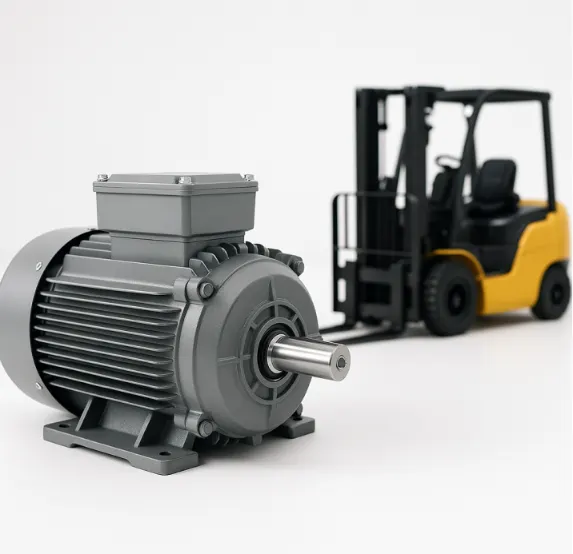
Forklift trouble often shows up in two simple complaints: the truck runs hot and the battery does not last the full shift. You can change drivers, slow down the pace, or add another charger, but if the traction motor is a poor match for the job, these problems keep coming back. The motor and its control are where heat starts and where most of the wasted energy ends up.
In electric forklifts, the main choice is between induction motors and permanent magnet synchronous motors (PMSM). Both can move pallets. The real question is how they behave in slow, heavy, stop-start warehouse work. Once you look at torque, losses, and cooling, motor type suddenly becomes the key link between overheated machines and short battery life.
Why Do Forklifts Overheat So Often?
Forklifts rarely cruise at steady medium speed. Most of the time they inch forward, stop for a pick, reverse, then repeat. Add full pallets, ramps at loading bays, and long shifts in warm buildings, and you have a tough environment for any traction system.
Heavy Loads and Continuous Low Speed Work
In many warehouses, a 1.5–3 ton truck spends its day with a heavy pallet on the forks or pushing loads on the ground. The forklift motor must supply high torque at very low travel speeds while the hydraulic system also draws power. Some compact trucks use 2–4 kW flat-wire AC induction motors at 60 V for this duty, which shows how much is asked from a relatively small frame in real work.
Poor Cooling in Indoor Warehouses
Indoor aisles do not have the airflow of an open yard. Dust, paper fibers, and heat from lighting and other machines raise the ambient temperature. If the motor relies on simple air cooling, that warm, dusty air does not help much. Once the housing and surrounding metal heat up, the motor has trouble getting rid of extra loss.
Inefficient Motor Operation at Low Speed
Many drives are sized with nameplate power in mind, not how the torque curve looks at 2–5 km/h. If the forklift motor runs far from its efficient region for hours, extra current turns into heat instead of useful work. That heat shortens insulation life and makes your battery feel “small” even when the pack is healthy.
How Does Motor Type Affect Heat and Battery Usage?
Motor type shapes how losses appear in the system. Two forklifts with the same battery and duty can behave very differently if one uses an induction motor and the other uses PMSM.
Rotor Losses and Heat Buildup
In an induction motor, torque comes from current induced into the rotor bars. That current creates rotor copper loss. In slow, high torque work, the loss is large and sits right where cooling is hardest. A PMSM rotor carries magnets instead of copper, so you remove that whole loss path. Less loss means less heat that your cooling system needs to deal with.
Torque Output at Low Speed
Forklifts live at low speed. PMSM designs provide high torque from zero speed with less stator current because the magnetic field is already in place. Induction machines need slip to build rotor field, so they pull more current for the same torque. That extra current warms the windings and drains the battery faster, especially in tight, stop-start routes.
Energy Efficiency During Stop Start Cycles
Across many applications, PMSM often reaches a few percentage points higher efficiency than comparable induction designs, and the gap can grow at light and mid load. In a forklift that runs two or three shifts per day, this can mean noticeably longer runtime between charges and less voltage sag near the end of the shift. That is where you see fewer calls about trucks “dying” halfway through the work.
What Makes PMSM a Strong Match for Electric Forklifts?
When you line up the duty profile of a typical electric forklift with the features of PMSM, the pieces fit quite well. You are asking for compact size, strong low speed torque, and good efficiency over long hours.
High Torque Density for Heavy Lifts
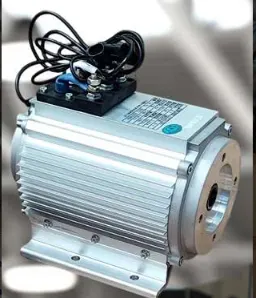
A high-torque PMSM motor can deliver more torque from a smaller frame than an equivalent induction motor. That helps when space in the chassis is tight and you still need strong launch under full load. Higher torque density also gives you a safety margin for ramps and rough floors without oversizing the whole drive.
Lower Operating Temperature
With fewer internal losses, PMSM tends to run cooler at the same output. Lower temperature rise supports longer insulation life and more stable bearing grease. For you that turns into fewer thermal trips and fewer motors that feel “cooked” after a hard summer shift.
Longer Battery Runtime in Daily Shifts
Better efficiency means more of each amp-hour goes into moving goods instead of heating copper and steel. Even a 5–10% energy saving across a shift can add 20–40 minutes of useful runtime, depending on your route and truck size. Over weeks, that reduces charging cycles and helps extend battery service life.
Are There Cases Where Induction Motors Still Work?
Even with these advantages, induction motors do not disappear. There are situations where they still make sense.
Budget Sensitive Entry Level Forklifts
If you run light duty forklifts in small warehouses, with short routes and long parking periods, the lower purchase cost of induction drives can outweigh the energy saving of PMSM. When the truck only runs a few hours per day, the efficiency gap has less time to show.
Environments With Very Short Routes
Some plants use small forklifts or tow tractors only to move loads between nearby stations. Travel distances are short and breaks are long. In those roles, a simple induction motor can live a long time with basic care, and changing to PMSM is less urgent.
Final Recommendation for Forklift Fleet Owners
If your trucks see heavy pallets, long shifts, and warm indoor aisles, motor type is not a small detail. Choosing PMSM over induction changes how much heat builds up in the drive and how far each charge carries you. For light routes and tight budgets, induction can still work, but for hard daily service, spending effort on better forklift motor pays back in fewer breakdowns and fewer mid shift charging pauses.
How ENNENG Supports High-Torque, Long-Duty Applications
Qingdao Enneng Motor Co., Ltd. (ENNENG) focuses on the design and manufacture of permanent magnet motors for industrial applications. The company develops low speed high torque drives, constant speed units, and direct drive machines that work across a range of voltage levels in sectors such as mining, rubber, water treatment, textiles, and process industries where energy saving and emission reduction are long term goals.
ENNENG works with PMSM motor series for heavy loads that support wide speed ranges, high power factor, and stable running in continuous duty. The company applies a “precision performance” concept to production, backed by modern testing and quality control aligned with national and international motor standards. For operators who are planning to move from traditional induction drives to higher efficiency industrial permanent magnet motors, ENNENG offers practical paths that focus on cutting electrical loss while keeping retrofits and site changes manageable.
FAQ
Q1: Why do some forklifts overheat faster than others?
A: Forklifts that run heavy loads at low speed with induction motors build more rotor and stator losses. In warm indoor air, that heat has nowhere to go, so the drive runs hot.
Q2: Will switching to PMSM always fix short battery life?
A: It will not fix every issue, but in many fleets PMSM cuts wasted energy in the motor, which gives longer runtime from the same battery and reduces voltage drop late in the shift.
Q3: Is a PMSM harder for technicians to work with?
A: Setup needs good motor data and vector control, but once parameters are loaded, daily checks are similar. Your team still watches temperature, vibration, and insulation like before.
Q4: Does PMSM make sense on small 1.5 ton forklifts?
A: Yes, especially if those small trucks run long hours or handle frequent ramps. The energy saving and cooler operation can still be noticeable even on compact models.
Q5: How do you choose between PMSM and induction for a new fleet?
A: Look at duty first. If your trucks work hard, run many hours, and often hit temperature alarms, PMSM is usually the better long term choice. For light, short routes, induction may still be enough.


